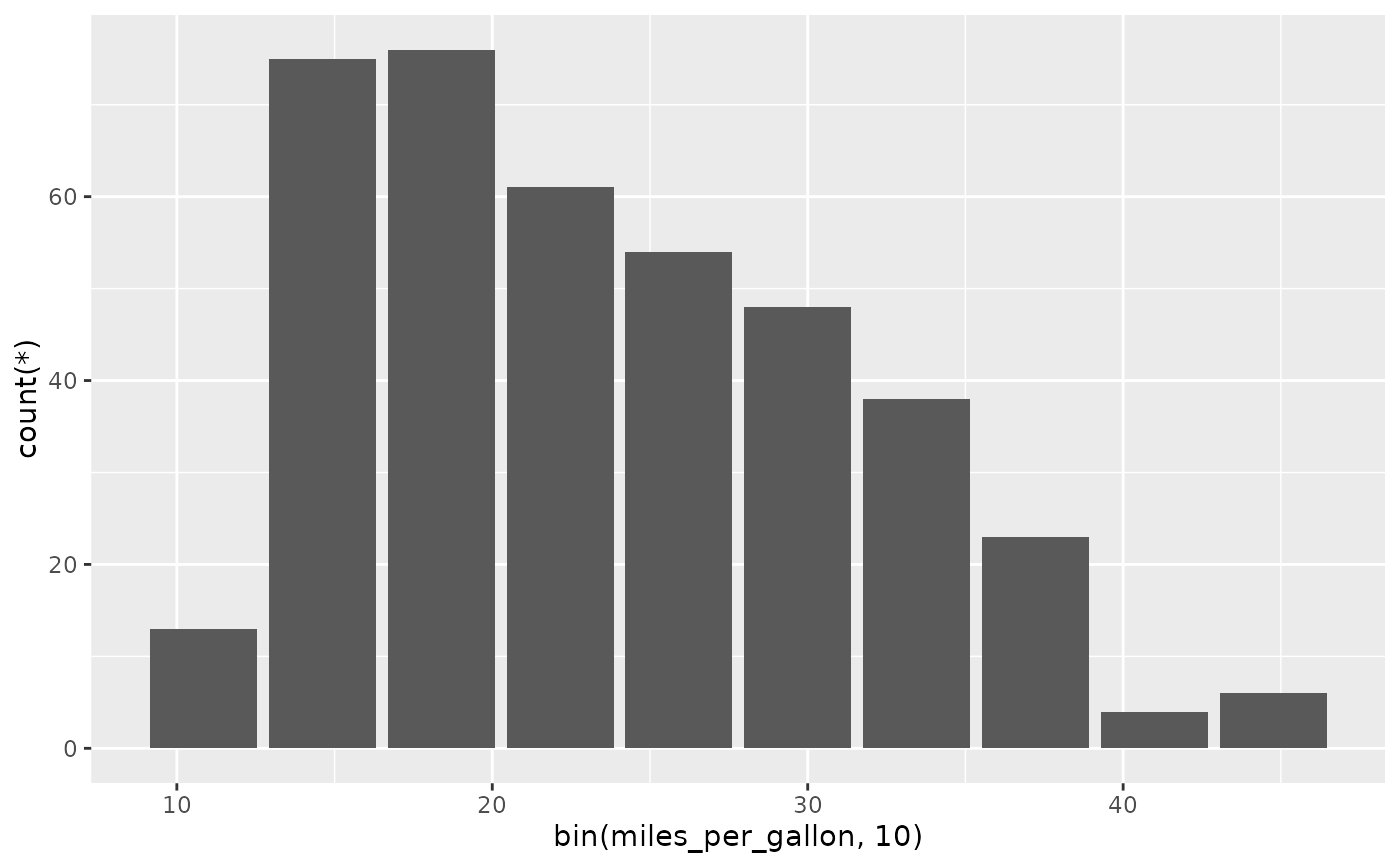
The bin function creates equal-width bins for a
column; original values are transformed into bin-center values.
Arguments
The name of a numerical column to bin (required).
The number of bins (optional, default
30).
Examples
library(duckdb)
con <- dbConnect(duckdb())
#> duckdb keeps downloaded extensions and secrets in a temporary directory:
#> ℹ /tmp/RtmpMm0YzW/duckdb
#> This is removed when the R session ends.
#> • Extensions are re-downloaded each session.
#> • Secrets are lost.
#> ℹ Run duckdb(shared_home = TRUE) (or create ~/.duckdb) to keep them (suitable for most users).
#> ℹ Run duckdb(shared_home = FALSE) to accept the temporary directory (and silence this message).
#> ℹ See ?duckdb_storage for details and alternatives.
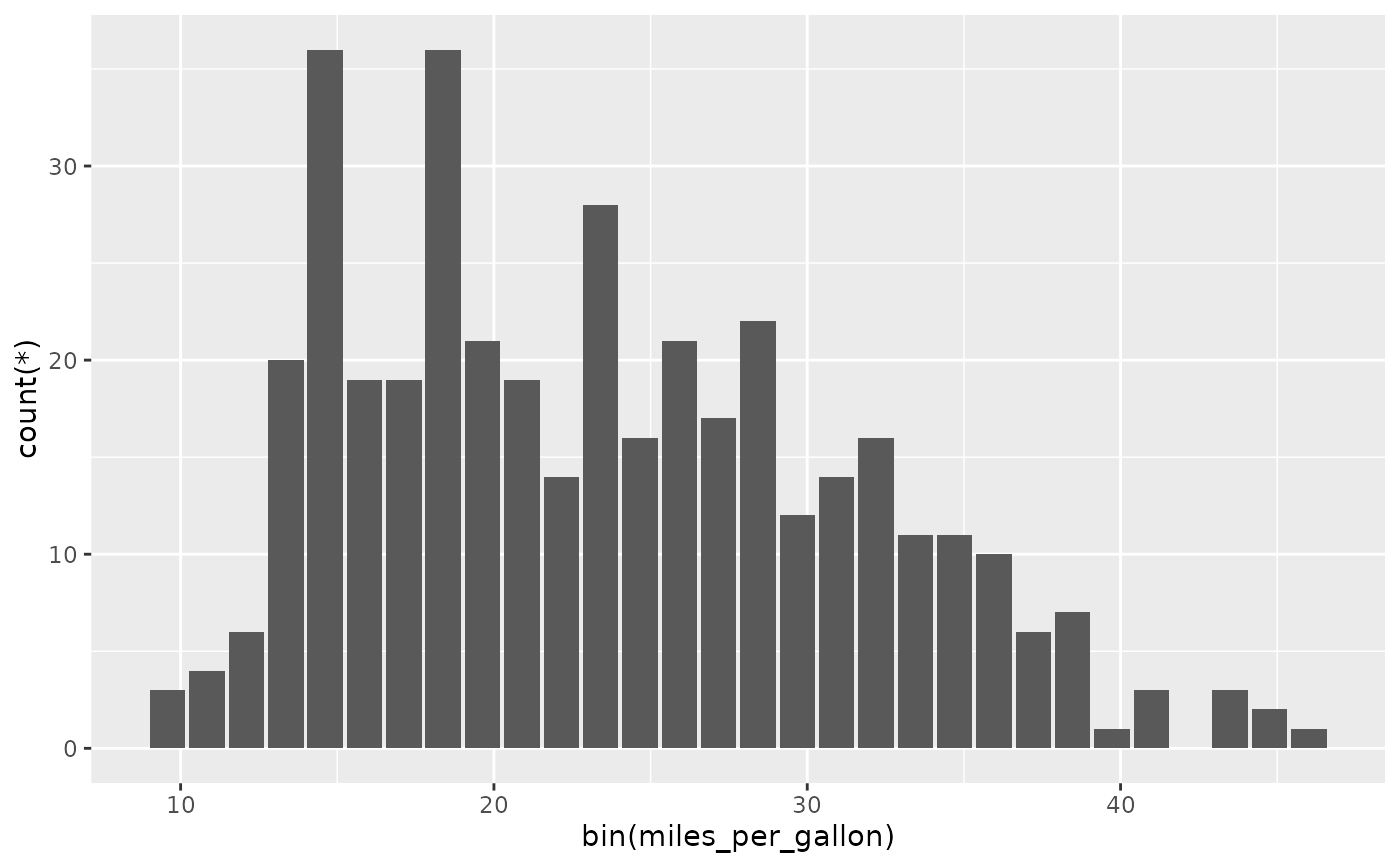
dbWriteTable(con, "cars", cars)
dbGetPlot(con, "
visualize
bin(miles_per_gallon) as x,
count(*) as y
from cars
group by
bin(miles_per_gallon)
using bars
")
 dbGetPlot(con, "
visualize
bin(miles_per_gallon, 10) as x,
count(*) as y
from cars
group by
bin(miles_per_gallon, 10)
using bars
")
dbGetPlot(con, "
visualize
bin(miles_per_gallon, 10) as x,
count(*) as y
from cars
group by
bin(miles_per_gallon, 10)
using bars
")